The service was the occasion, but what matters on Jamais’s Volvo Penta D1-13 is two disciplines: genuine parts to the Volvo calendar, and the upstream work that actually decides reliability. The job was done in April 2026, with the boat on the hard, before her early-May launch.
Service to the calendar, not the hours
Volvo Penta’s D1-13 schedule runs by hours or by the calendar, whichever comes first. A sailboat used mostly under sail puts very few hours on its diesel in a season — Jamais’s D1-13 shows just 102.7 hours — and rarely reaches the hour threshold in a year. But the annual deadlines still apply: engine oil oxidises and filter and pump gaskets age on the calendar, not on running hours. So the service is done on time regardless. It is the point people skip, and it is exactly the one that keeps the engine sound.
Genuine parts, dated, with one deliberate exception
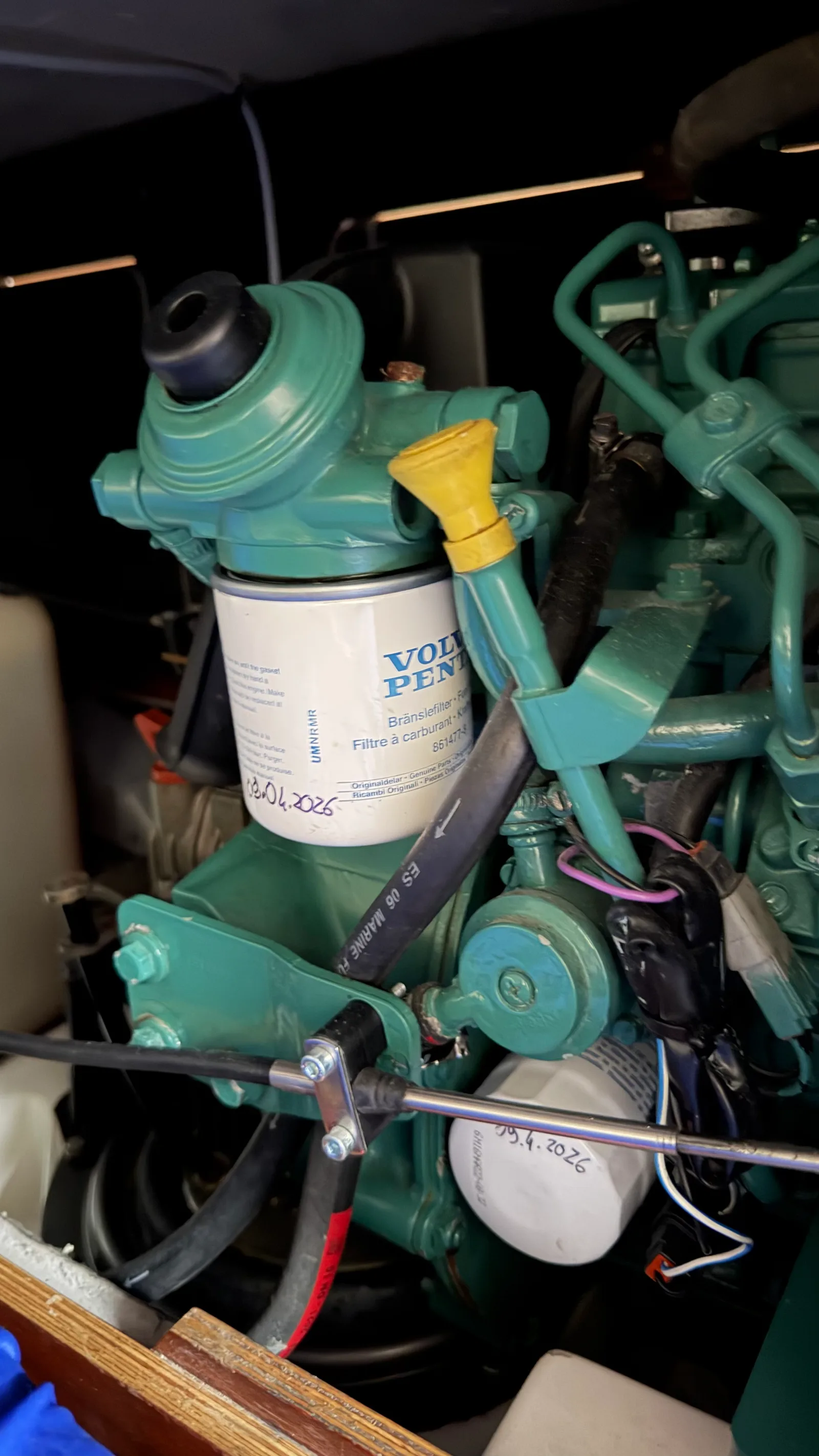
Every consumable was a genuine Volvo Penta part, taken as a single service kit: the drive belt, the oil filter, the fuel filter, and the raw-water pump impeller with its lubricant and gaskets. A saildrive diesel is not where you save a few francs on fit or spec — genuine parts seal, tension and flow as the engine expects.
One detail worth the discipline: each filter is dated by hand on fitting, straight on the canister. Years later the next interval is unambiguous — and whoever works on the engine after me knows exactly what is fitted, and since when.
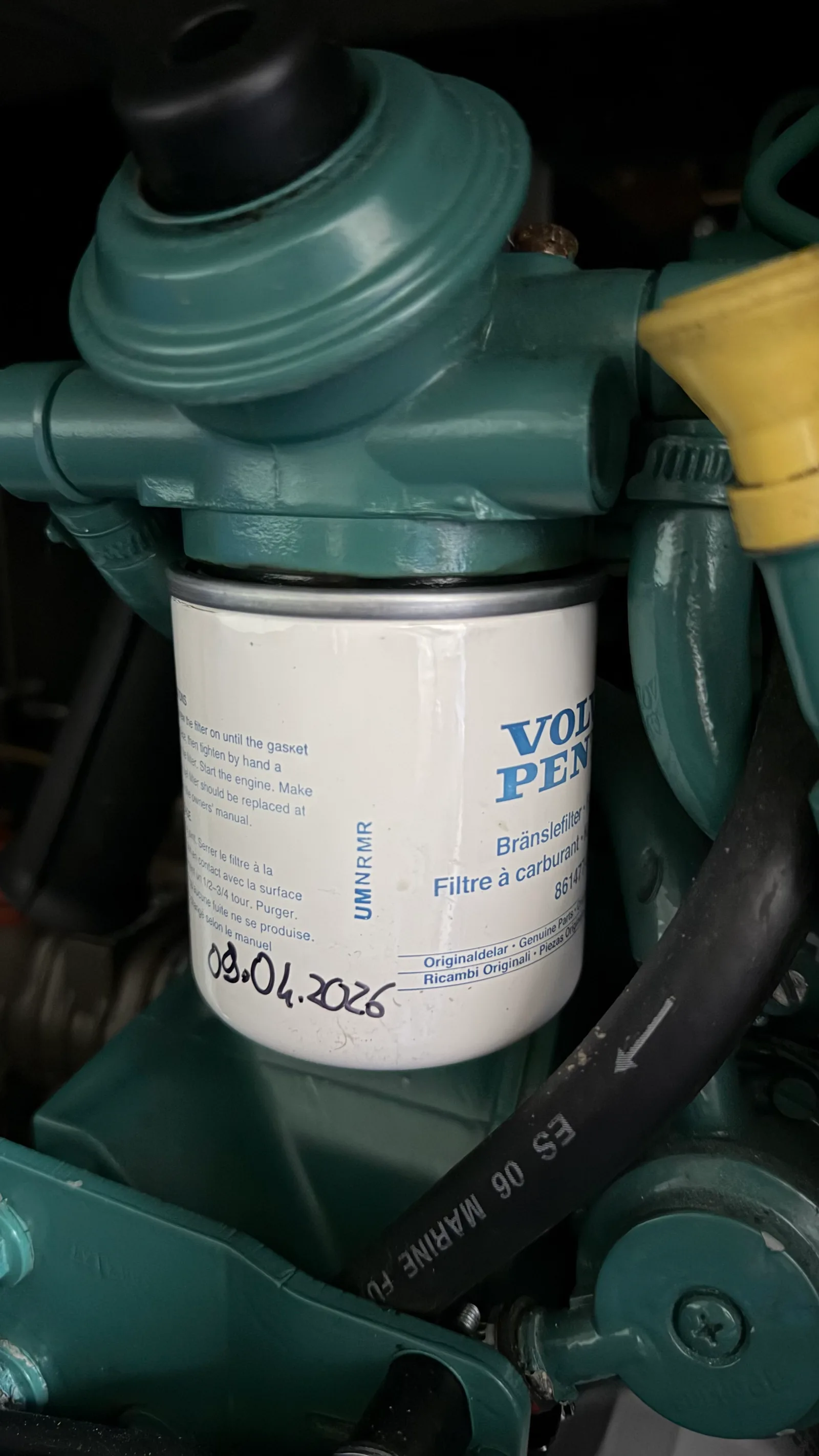
The one part that is deliberately not genuine Volvo is the diesel pre-filter — and that’s the one place an aftermarket design does better (below).
Two oils, not one
The service changes two oils, not one: the engine, and the leg — the sail drive and its reverse gear. The leg oil is the one owners forget, and it’s the one that tells you the most. Renewing it is your window onto the drive seals: clean oil is fine, but milky, emulsified oil means water is getting past the seal — caught early as a check, not late as a failure. You change it to lubricate; you inspect it to catch trouble.
The official Volvo Penta service protocol — A schedule
The annual A service (200 hours, or 12 months whichever comes first) prescribed by Volvo Penta for the D1-13:
| Operation | Action |
|---|
| Engine oil and oil filters | Replace |
| Fuel filter (engine) | Replace |
| Transmission oil (Sail Drive) | Replace |
| Seawater pump impeller | Inspect |
| Fuel pre-filter (water / contamination) | Clean |
| Seawater filter | Clean |
| Anodes | Inspect |
| Drive belts | Inspect |
| Coolant and antifreeze mixture | Inspect |
| Propeller shaft | Lubricate |
| Exhaust hose | Inspect |
| Seawater intake | Inspect |
Every 400 hours or 12 months (B), add the pre-filter cartridge, the fine fuel filter, the vacuum valve, idling, the Sail Drive rubber seal and the folding propeller. The air filter and a fresh impeller move to C (24 months / 400 h). Valve clearance, exhaust hose and drive belts go to D (48 months / 600 h). Coolant replacement is rare — E, 48 months / 2000 h. The Sail Drive rubber-through-hull seal is an F item, replaced every 84 months.
Why change the diesel pre-filter
The old pre-filter was a CAV 296 type: a centre-bolt design, where the cartridge is held by a bolt that runs through the body. Every change means undoing that bolt and getting covered in diesel. And the cartridge was due anyway.
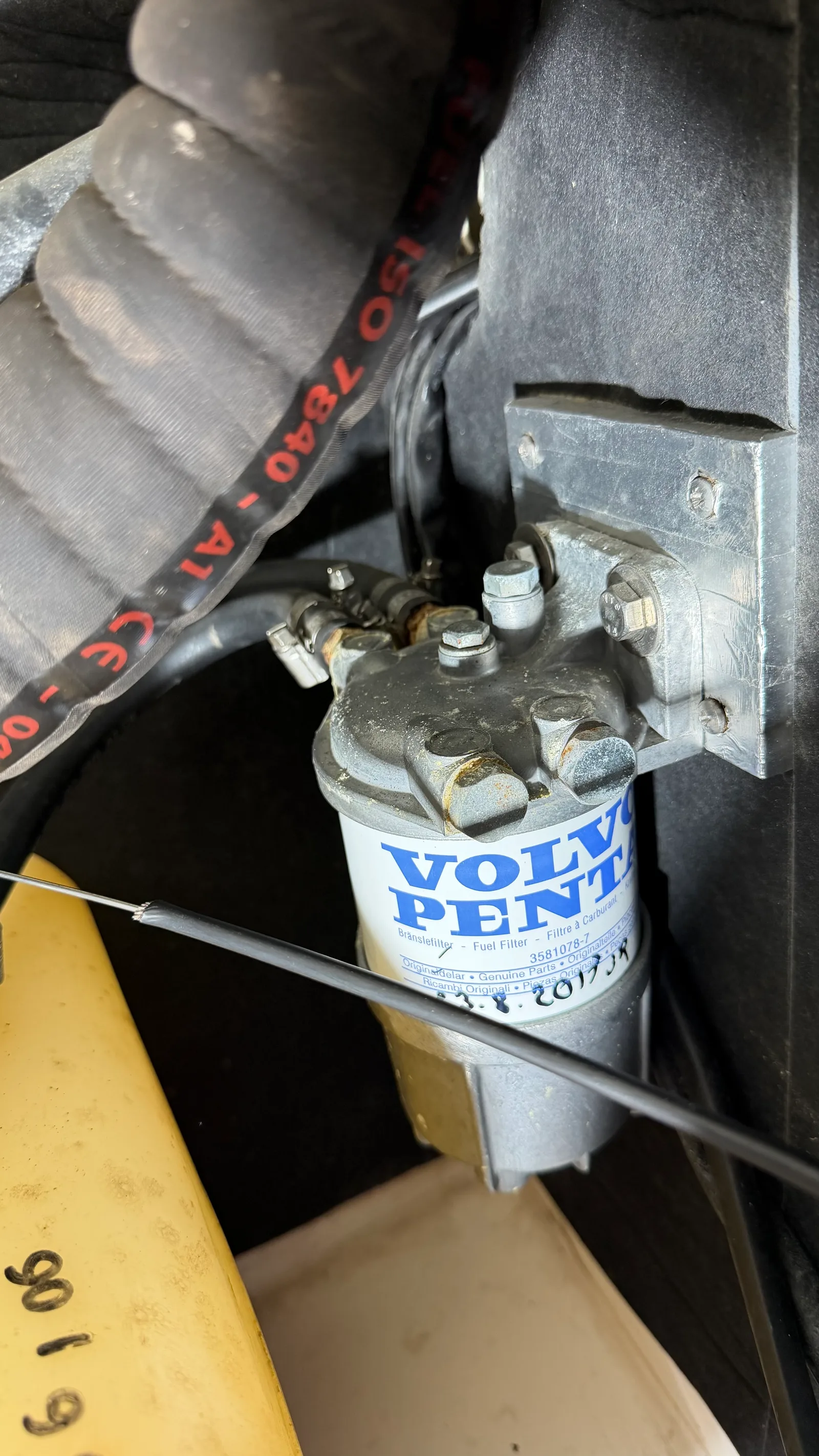
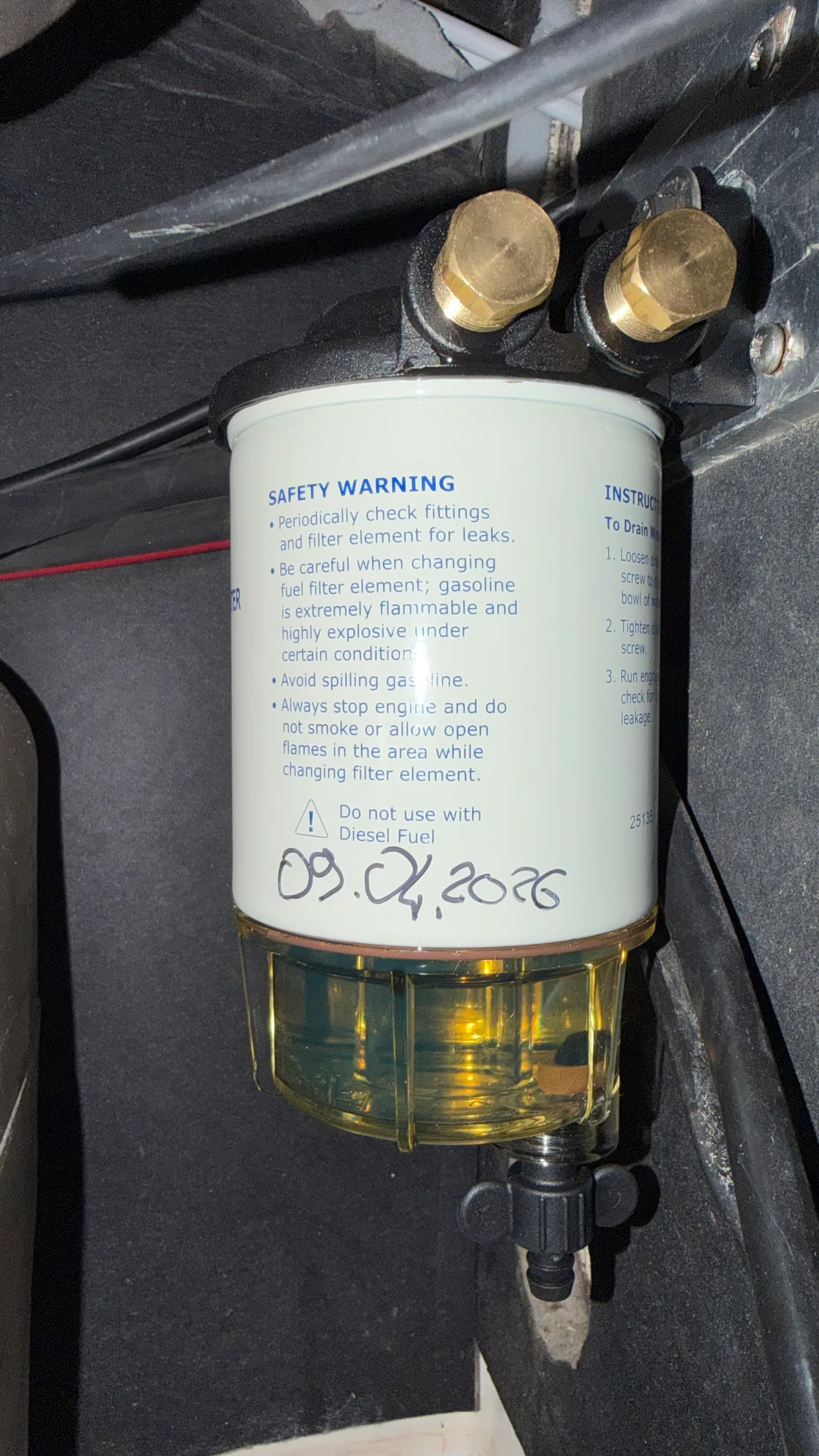
Rather than service a design that fights you, a modern pre-filter was fitted, and it earns its place three ways:
- a clear bowl — you see water and impurities at a glance, before they reach the engine;
- a drain tap — you empty the bowl of water, or drain it to change the cartridge, cleanly;
- a spin-on cartridge — the change is quick and clean, no centre bolt, no mess.
On a diesel, water in the fuel is the number-one cause of trouble: being able to see it and drain it turns a breakdown into a two-minute check.
Why new fuel hoses
The existing hoses were probably original. Removing the old pre-filter meant cutting them — the unions were so encrusted they wouldn’t come apart — which left them too short to reuse. So they were renewed for two reasons at once: length, and age. And renewed in proper marine fuel hose — rated for fuel and for fire in an engine bay, not generic tubing. Old hose hardens, cracks and can weep; a fuel line seeping in the engine bay is a fire and failure risk you don’t gamble on.
FAQ
Do you service by hours or by the calendar?
Whichever comes first. On a lake boat the 12-month deadline governs, because oil and gaskets age on the calendar even without the hours.
Why change the sail-drive (leg) oil too?
To lubricate, and because it reveals water past the seals early: milky, emulsified oil is the first sign.
Why genuine Volvo parts but an aftermarket pre-filter?
Genuine everywhere fit and spec matter; the pre-filter is the one place an aftermarket design (clear bowl, drain tap, spin-on cartridge) beats the original.
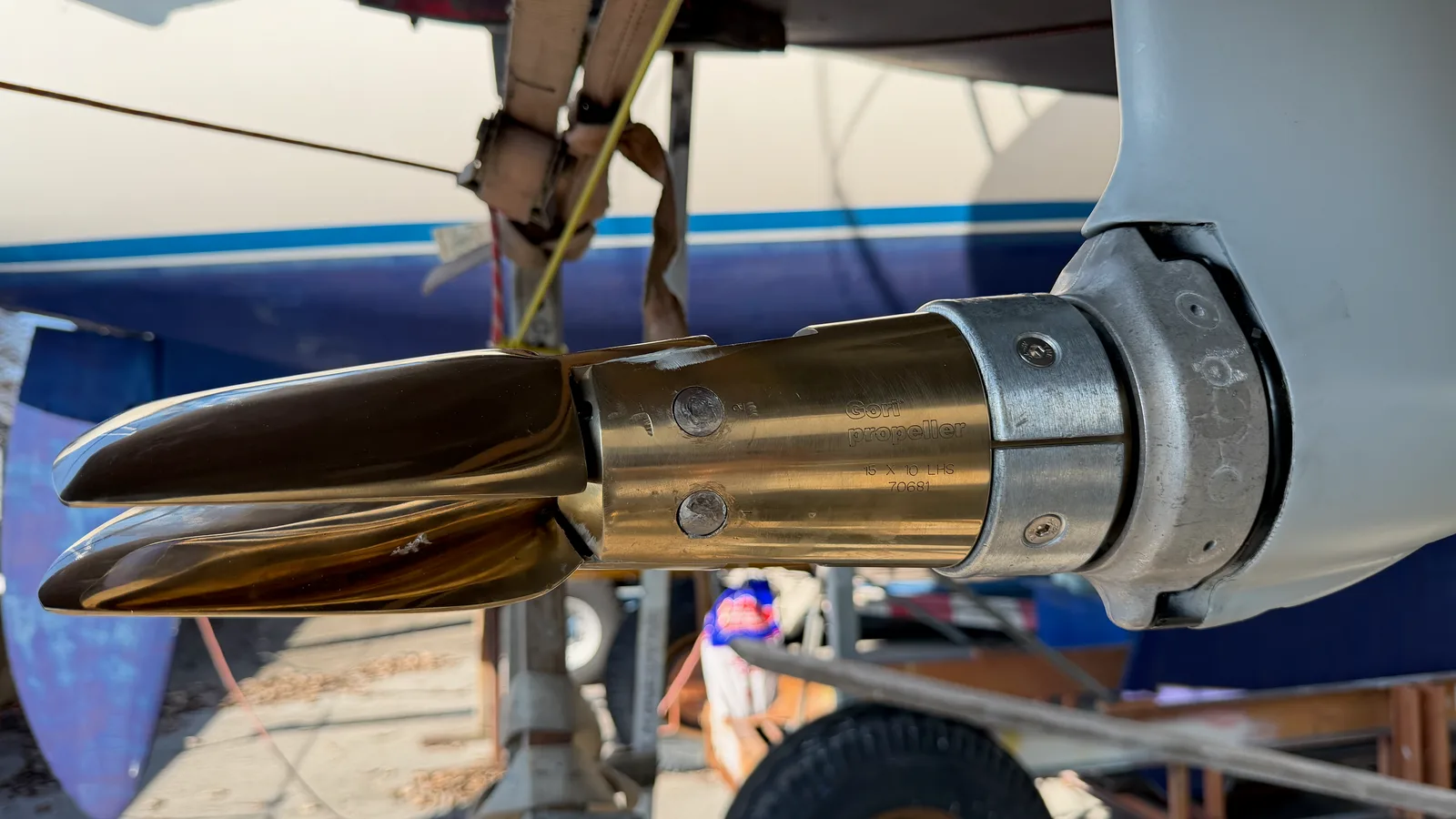
This job is part of Jamais’s logbook. See also servicing the Gori prop and Sail Drive.